
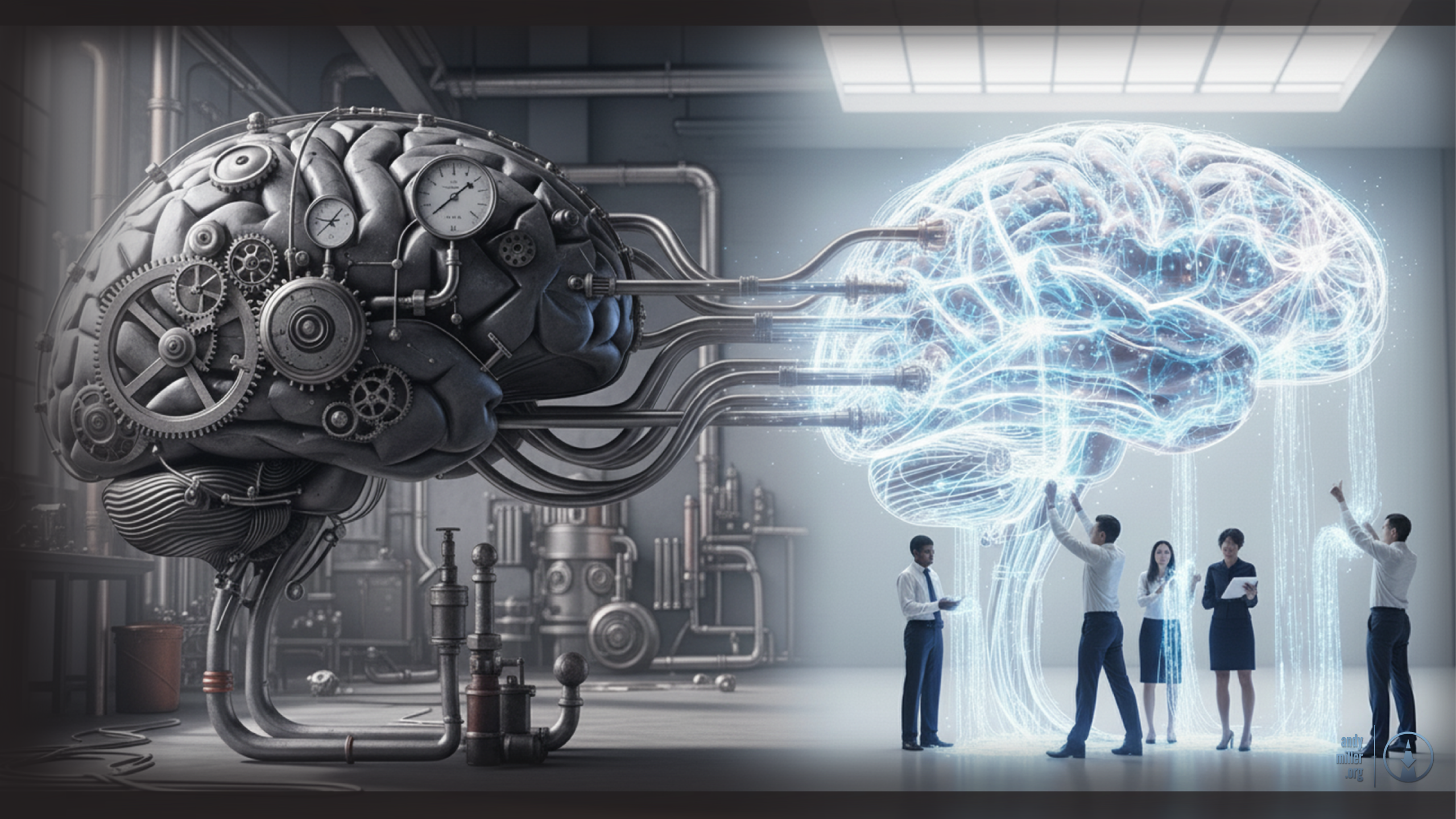
The first era of AI helped create content, where the second will create comprehension.
Marketing teams are building a “corporate second brain” – an intelligent system that learns from sales, product, and customer channels using secure, finely-tuned AI infrastructure to develop genuine business insights.
Rather than merely storing company data, the corporate second brain is a living system that stores and synthesizes data, transforming scattered signals into unified organizational comprehension.
“There’s no question we are in an AI and data revolution, which means that we’re in a customer revolution and a business revolution,” said Clara Shih, CEO of Salesforce AI.
As businesses confront the limits of AI-generated content, AI is now being used to build (these) corporate systems that function as an active reasoning layer to interpret, connect, and predict.
The practical payoff is the generation of genuine, authentic insights to understand customers, identify narratives, and drive growth.
ENTERPRISE THINKING
Arianna Huffington, founder of the Huffington Post, said, “People think in stories, not statistics, and marketers need to be master storytellers.”
By integrating finely-tuned models within cloud infrastructure, organizations can transform isolated datasets into actionable comprehension, which turns AI from an automation tool into a driver of understanding.
True customer intent emerges through the connections between fragmented information, such as support tickets, web sessions, and sales notes.
Marketing teams can use this intelligence to fuel smarter storytelling, develop hyper-personalized messaging, and detect emerging market demand before the competition.
THE PERFECT SALES PITCH
Imagine an AI-driven workspace that continuously develops context-specific recommendations and surfaces the right case study for a hesitant buyer, or offers the latest product update addressing a known objection.
According to Harvard University, “AI provides real-time insights into how customers behave all across the sales process, from initial engagement to (their) final purchase – the instant feedback allows marketers to adjust campaigns, messaging, and consumer recommendations on the spot, based on (their) up-to-the-minute behavior, ensuring that businesses can take advantage of opportunities as they present themselves.”
Instead of relying on static dashboards or quarterly reviews, sales leaders can learn what their prospects care about and why – immediately.
HELP FROM ABOVE
Cloud AI provides the computational backbone of the corporate second brain, enabling secure, scalable, and continuously-learning intelligence systems that operate across enterprise data streams.
Each cloud ecosystem contributes distinct strengths to this transformation:
• Google Cloud (Vertex AI): Purpose-built for model tuning, real-time reasoning, and cross-data orchestration.
• AWS Bedrock: Enterprise-grade foundation emphasizing modular model access and governance at hyperscale.
• Azure AI: Seamlessly fuses productivity ecosystems with intelligent services for embedded organizational insight.
FEEDING THE BEAST
Creating relevance is critical to this process and requires high-quality company data to maintain meaningful output, such as CRM, web analytics, customer service transcripts, sales feedback, etc. – excluding the use of generic, external datasets.
“It is the incremental use-case or client-specific data that is used to fine-tune and adapt the baseline model to perform optimally for different use cases,” said Kirti Vashee, in The Importance of Data Quality in AI.
Enterprise-grade customization relies on finely-tuned AI models trained on proprietary data to bridge surface-level automation with authentic company-specific insight.
For example, a healthcare procurement platform can identify new product opportunities by linking buyer behavior, feedback loops, and usage trends through its corporate second brain.
Each customer interaction refines system intelligence, which improves narrative accuracy and strategic foresight over time.
ONWARD AND UPWARD
As technology yields more AI-based innovation, LLMs will continue to play an important role in content generation, while the real breakthrough lies in the development of systems that can “think” as the organization does.
“The most successful marketers will be those who learn to seamlessly integrate AI technology while maintaining the irreplaceable human touch,” said Angeley Mullins, Forbes Council member.
The Corporate Second Brain represents this evolution: a unified layer of intelligence connecting what a business knows with what it needs to understand next.